The Importance of Semantics: Aligning on the Variables
When you ask an asset team how full the building is, you still get five different answers. This isn't a data failure, it's a semantic one.

In our last session, we drew a line in the sand: Retention is a behavioral math problem, not a relationship story. Our position is that the industry is optimized to explain outcomes after the fact, and the next decade belongs to those who can predict behavior in real-time.
But to solve a math problem, we all have to agree on how the variables are defined.
Commercial real estate is currently drowning in a sea of badge swipes, WiFi pings, and sensor logs. Yet, when you ask an asset team "How full is the building?" you still get five different answers. This isn't a data failure, it's a semantic one.
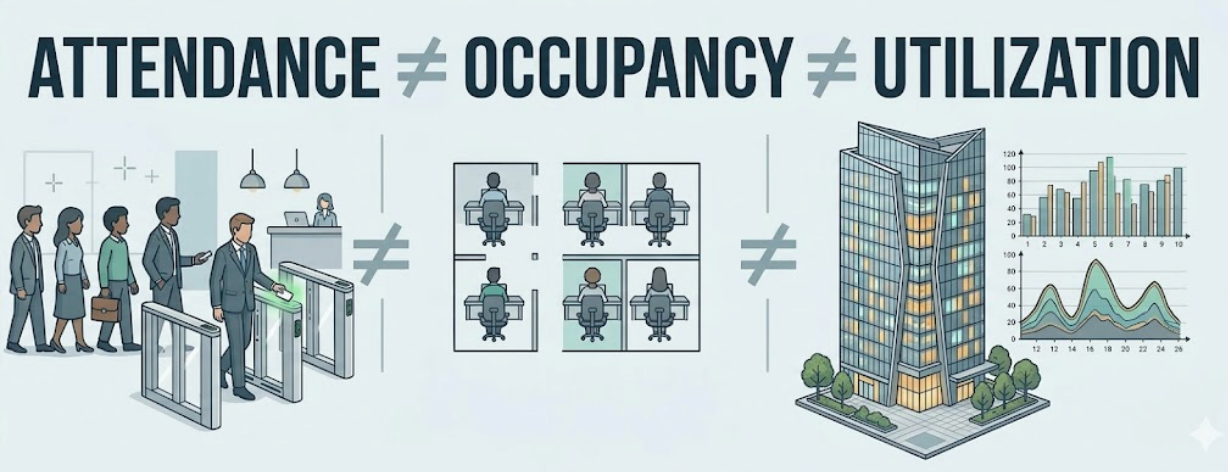
If we are going to move from "hope-based" amenities to Attributable Retention Revenue, we have to stop using utilization, occupancy, and attendance interchangeably. When definitions blur, your data becomes a liability.
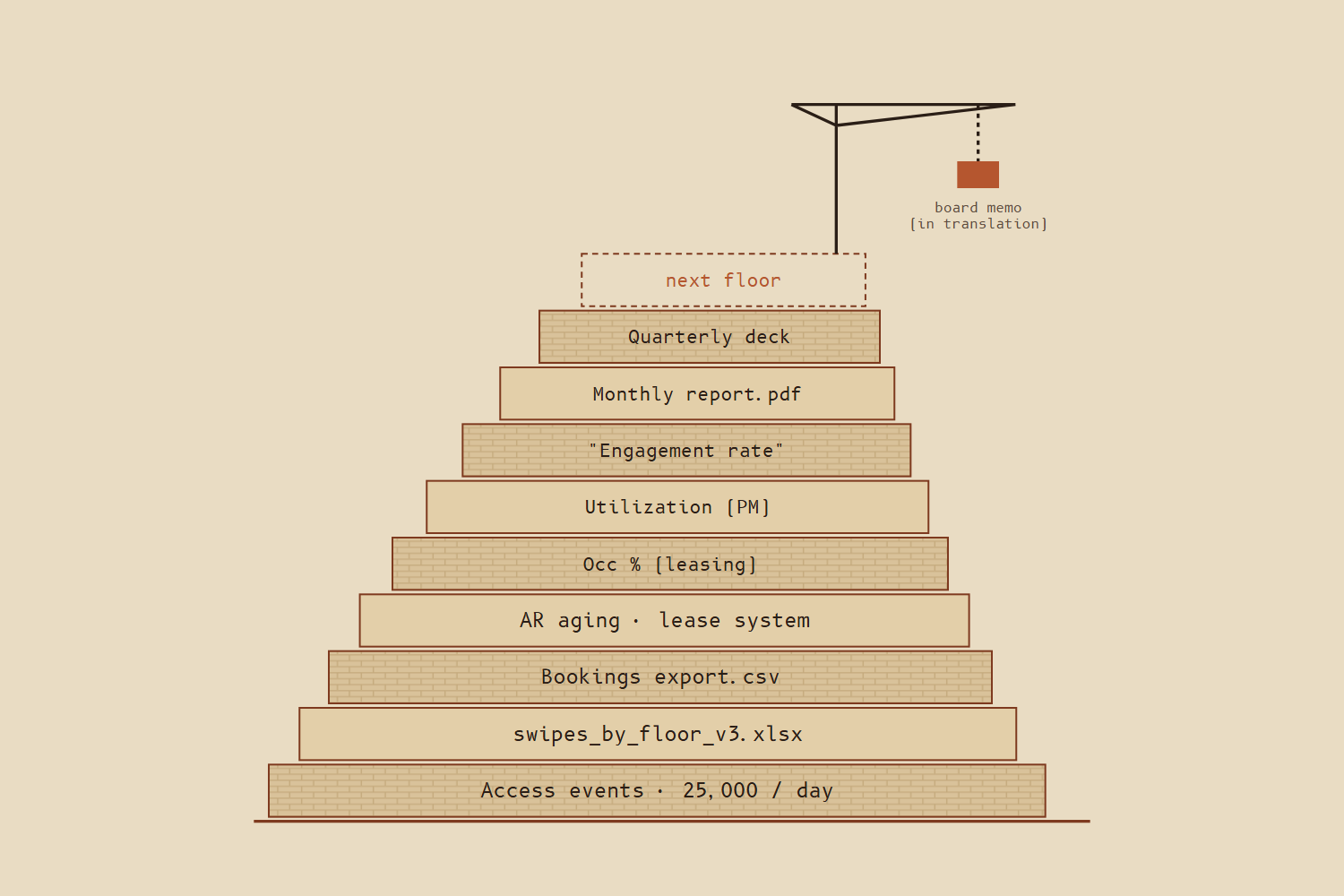
This whiteboard deconstructs the behavioral stack. Before we look at the code or the ROI, we have to get the language right.
Observation
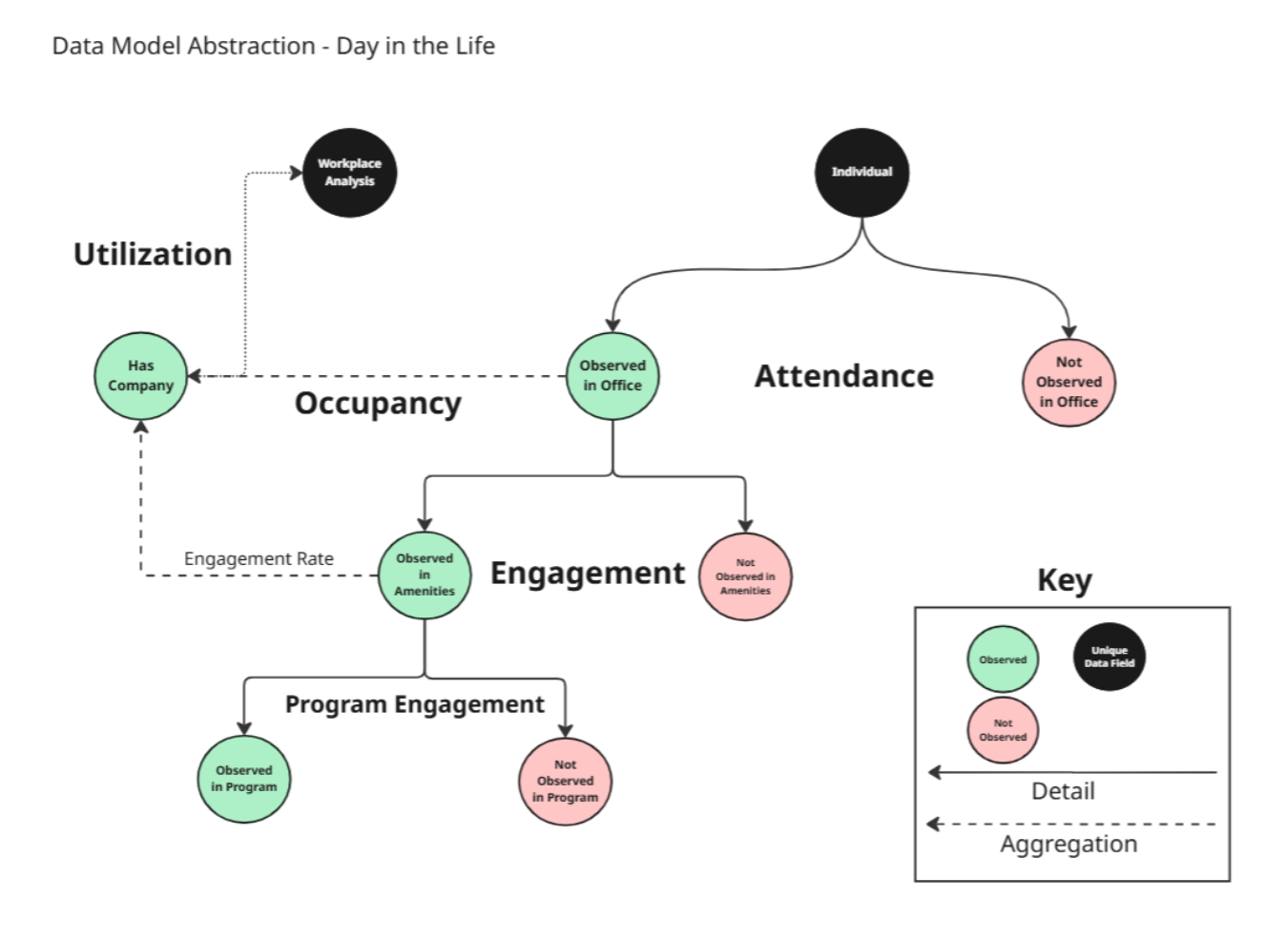
Everything begins with a simple concept: observation. At the most granular level, we are simply asking whether an individual was observed in the building on a given day.
Whether that signal comes from access control, WiFi association, or amenity check-ins, it is the raw "atom" of our model.
As seen in our Data Model Abstraction (Day in the Life), this single observation is the starting point for a hierarchy of understanding.
Attendance
Attendance answers a simple, binary question: Was this individual observed in the office today?
This is the most basic behavioral signal we can measure. It tells us nothing about what the person did in the building, only that they were present. Attendance is a person-level signal; when aggregated across a tenant population, it becomes the clearest indicator of workplace patterns.
Engagement
Once someone is present, the next question is tactical: Did they interact with the building experience?
Engagement measures whether an individual who attended the office also interacted with a building amenity, service, or program such as visiting the fitness center, using a shared lounge, or logging into building WiFi. Engagement represents a step beyond mere presence. It tells us the building is not just being occupied, but actively used.
Program Engagement
Within Engagement, we go deeper into the "hospitality layer." Program Engagement measures whether an individual participated in a specific activation, such as a hosted event or a building-sponsored service.
This is where property operations and hospitality strategies become measurable. It is the only way to move past anecdotal feedback and understand which programming actually resonates with the tenant base.
Occupancy
While Attendance and Engagement operate at the individual level, asset and leasing teams think in terms of tenants. Occupancy is created when individuals are mapped to their tenant company and Attendance is aggregated across that population.
Occupancy reflects how many employees of a tenant are actually using their space. It bridges the gap between raw behavioral signals and the financial reality of the lease.
Utilization
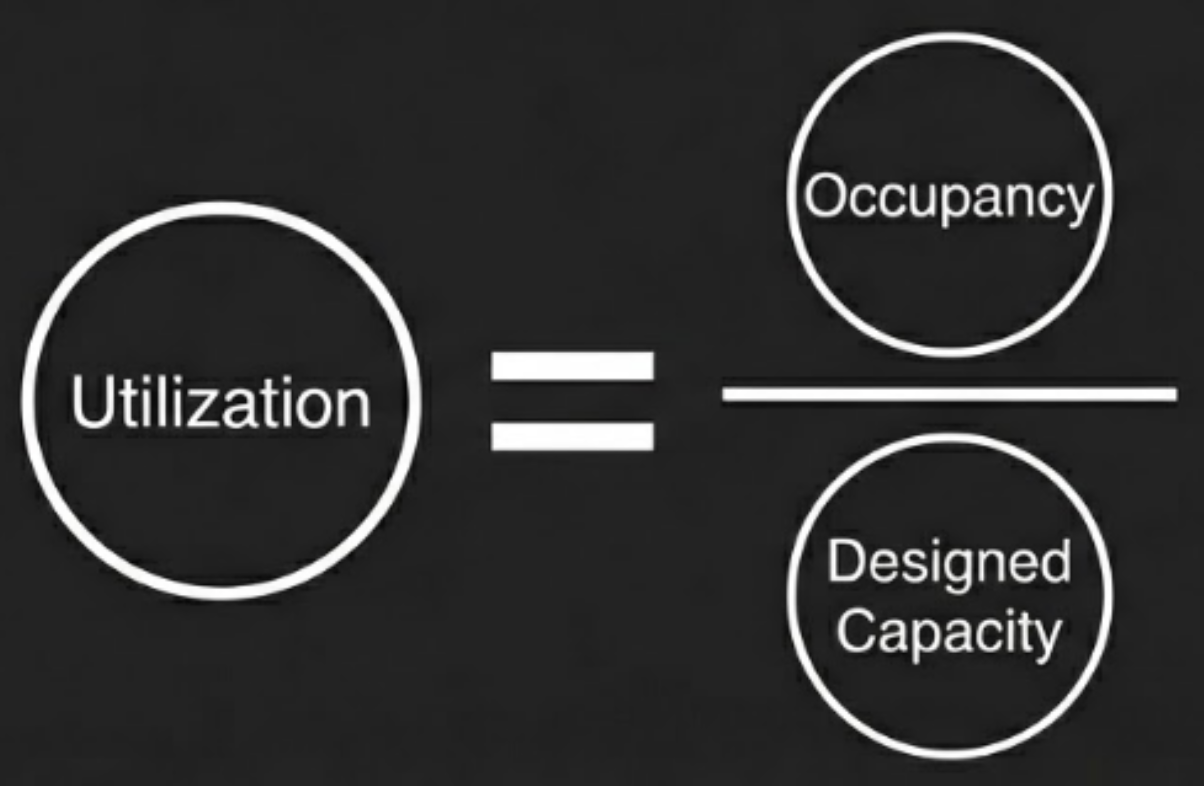
At the top of the stack, we arrive at Utilization. This is a workplace analysis problem. It isn't just about how many people are present; it's about analyzing that presence relative to physical capacity. A law firm where everyone has a private office vs. a tech startup where there's a 3:1 desk sharing ratio have very different designed capacities.
Utilization asks: How efficiently is the space being used relative to its capacity? Where are the "redline" peaks and "fading" troughs? Utilization synthesizes individual activity into an operational understanding of how efficiently a space is being used.
The Takeaway
When these terms are used interchangeably, the industry ends up talking past itself. This semantic sloppiness is why Attendance gets labeled as Occupancy, and Occupancy gets labeled as Utilization. The result is a series of metrics that appear precise but are actually describing entirely different realities.
For owners, the consequences are financial. Decisions about leasing strategy, amenity CapEx, and operational programming depend on understanding how tenants actually behave. Without clear semantics, that behavioral intelligence is just noise.
What Comes Next
This is the foundation.
Because once the semantics are clear, the real opportunity begins: translating tenant behavior into better outcomes for owners.
Want to learn more about how we help teams measure Engagement and better understand retention? Reach out and let's chat.
The REKalibrate platform provides a single source of truth for tenant behavior and asset performance. By leveraging first-party data, we help office owners move from anecdotal intuition to predictive intelligence and data-driven justification.