Cleared for Approach: Aviation Had Its Tower, Too
Every industry that solved its coordination problem did the same three things. It is time for ours.

Three issues. Three problems. Greetings From Your Building: a monthly report curated, compressed, and mailed long after the fact, passed off as the view from your own building. Winchester Garage: an owner with no key to data locked inside vendor systems she was paying for. The Tower of Babel: one tenant going by seven different names, occupancy carrying five competing definitions depending on who you asked.
If you have been reading along, the picture is clear. This issue is about something different: how another industry, facing the same kind of chaos, fixed it.
Aviation Had Its Tower, Too
Before 1944, commercial aviation was expanding faster than anyone had agreed on anything. Airlines used their own terminology. "Runway" meant different things at different airports. "Clear" did not carry the same meaning from one tower to the next. A pilot flying across multiple countries was effectively switching languages mid-flight, governed by whatever the local controller happened to use.
The chaos was not technical. Aircraft worked. Radios worked. The problem was that no one had agreed on what words meant or how to describe where things were. Aviation had a coordination problem that looked exactly like an information problem, because that is what coordination problems always look like from the inside.
The Agreement
In December 1944, fifty-two countries sent delegates to Chicago. The Convention on International Civil Aviation produced something that did not look dramatic on paper: a shared protocol layer. Not a new kind of aircraft. Not better radios. A set of agreements about what things would be called, how entities would be identified, and what information everyone would see.
The protocol layer did not replace the airlines or the airports. It sat beneath all of them. Each carrier kept its own operations, routes, and culture. The agreement was only about what they would share and how they would describe it.
What the Controller Does Now
A controller working a busy approach sequence does not spend time reconciling terminology. She does not ask what an airline means by "ready" or confirm which runway numbering convention they are using. The definitions were settled before the flight took off. The protocol layer is invisible because it works.
She flies the plane. The agreement freed her to do the actual job.
That freedom did not come from better technology. It came from fifty-two countries in a room in Chicago agreeing that the work of coordination was too important to leave to improvisation.
Your Building Is Already Broadcasting
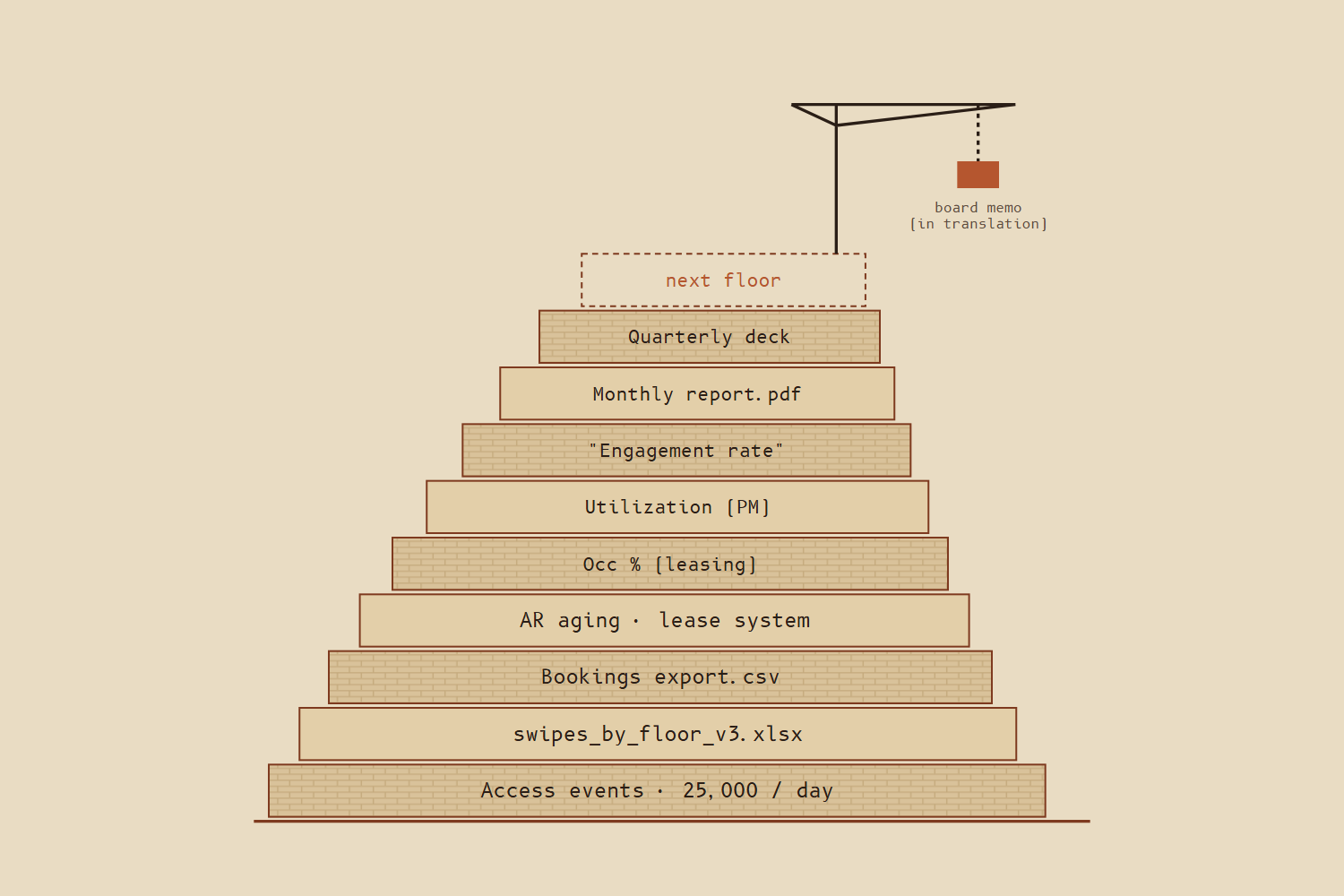
A large commercial property generates tens of thousands of records a day. Badge readers. Desk reservations. Visitor logs. Food and beverage transactions. Meeting room bookings. HVAC adjustments. The data exists. It has always existed.
The problem is not that buildings lack information. It is that the information cannot coordinate. Each system speaks its own language. Each report is compiled differently. Each team carries a version of the truth that is slightly inconsistent with every other version. The asset manager's occupancy number does not match the operator's. The operator's does not match the broker's. Nobody is lying. Nobody is using the same definition.
Sound familiar?
connected
metrics defined
The Three Problems, Revisited
Three issues. Three problems. Here is what the equivalent of the Chicago Convention looks like, applied to each one:
Someone Has to Write It Down
ICAO did not emerge from committee silence. It emerged from enough near-misses that the industry reached a conclusion: this cannot continue. Someone has to write the standard.
They wrote it. Fifty-two countries signed. Not because everyone agreed on every detail at the start, but because the cost of not agreeing was too high to keep paying.
The equivalent document for commercial real estate does not exist yet. There is no shared definition of "active." There is no single standard for how occupancy is calculated. There is no agreed protocol for what happens when a person appears in six systems under six different names.
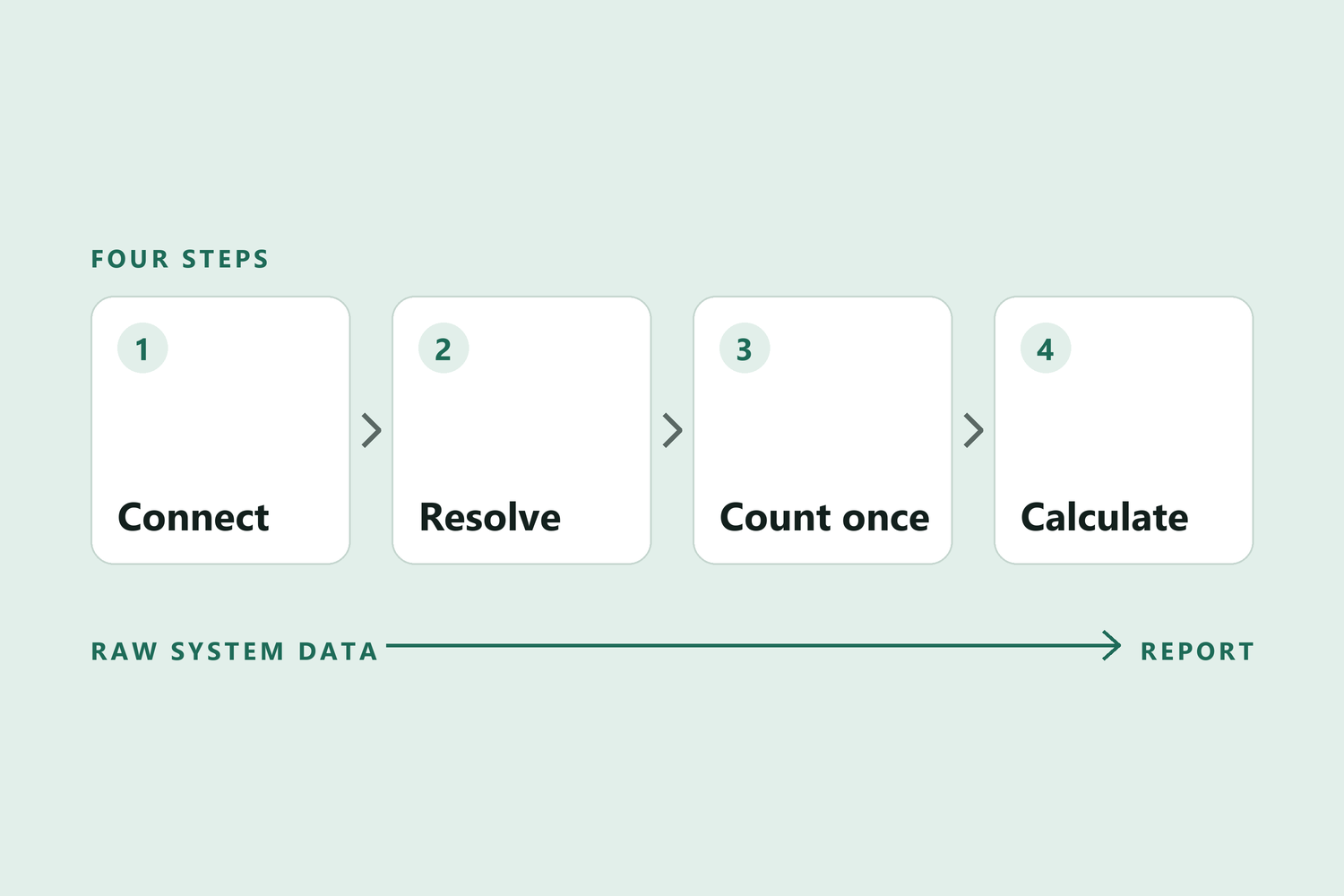
We have been building one. Not a product to sell. A standard to share. Four steps: connect the systems, resolve the identities, count once, calculate from a single governed definition. The work is not glamorous. But establishing one governed definition of a term like "active" is what lets every team and every screen show the same number.
That work starts below the surface. Before any metric can be defined, the raw data has to be normalized: what is common across systems separated from what is vendor-specific. A single property management platform can represent the same concept ten different ways. A single system type can come in many flavors. The first year and a half of building REKalibrate went into that layer, creating a framework extensible enough to absorb new data types without rebuilding from scratch. The semantic layer sits on top: shared business logic and metric definitions, enforced in code, so that a metric means the same thing wherever it appears.
Consistent definitions make something else possible that is difficult to replicate in-house: benchmarking. When occupancy is calculated the same way across every building, buildings can be compared. When engagement is defined the same way for every tenant, you can see what good looks like relative to peers. That comparison is the output. The standard is what makes it possible.
Draft 1
Here is where we have started. Five terms. Defined once. We are calling this Draft 1 because that is what it is, and because standards are written by disagreement, not committee silence.
| Term | Definition |
|---|---|
| Profile | One person, across all connected systems. All identifiers matched and resolved to a single record. A Profile is the unit of analysis. Not a badge number. Not a system ID. |
| Entry Day | One physical arrival per person per day, counted in local time. If you leave and return, it is still one Entry Day. The metric measures presence, not door events. |
| Touch Point | A record that something happened in a program. System-created, not self-reported. Touch Points are not Profiles: one person can generate many. They record events, not people. |
| Active | At least one event in the trailing twelve months. This is the denominator. Every metric built on a population needs to agree on who counts as active before it can mean anything. |
| Occupancy (daily) | Distinct people present on a weekday. Not leased square footage. Not badge swipe count. Not RSVP count. Not survey responses. People. Present. On a weekday. |
One More Thing
The first thing an AI model reaches for, when you point it at a dataset, is a definition. What does this column mean? What counts as a record? What is the denominator for this rate?
If "active" means something different in every system, the model compounds the ambiguity. It does not resolve it. Doing the definitional work once, in a shared layer, means an AI agent does not have to reconstruct business logic from scratch on every question. That keeps answers consistent and usage costs in check. Machine-readable definitions are not a technical nicety. They are the prerequisite for everything AI is supposed to do with this data.
Aviation did not build autopilot on an improvised language. The automation came after the protocol. It always does.
Who Writes the Standard?
The controller does not argue about what "west" means anymore. She flies the plane. The Chicago Convention made that possible, not by building better aircraft, but by getting delegates from fifty-two countries to agree on a shared language.
This industry will get there. The question is who writes the first draft. We have started. If your definition of "active" or "occupancy" looks different from the one above, tell us. That is how the standard gets written.